
As is well known, one of the key technological innovations linked to the development and establishment of the cello was the introduction—around 1660—of metal winding on gut strings.
This improvement made it possible to increase the density of a string, thereby achieving a lower frequency while simultaneously reducing its external diameter.
Prior to this technological advancement, the only way to produce low-pitched sounds was to use instruments of considerable size, ensuring a sufficiently long vibrating string length.
If the instrument were too short, the phenomenon of string inharmonicity would occur.
This happens when the diameter is too large in relation to the vibrating length and the tuning frequency; as a result, the string, when vibrating, behaves more like a “beam” than a “flex rope.”
From an engineering perspective, one must compare the string’s moment of inertia J (which is proportional to the fourth power of its diameter d) and elastic modulus E (or Young modulus) against the square of its vibrating length L, while also accounting for the role of the applied tension F.
B=\dfrac{\pi^2EJ}{FL^2}Inharmonicity: flex rope and beam
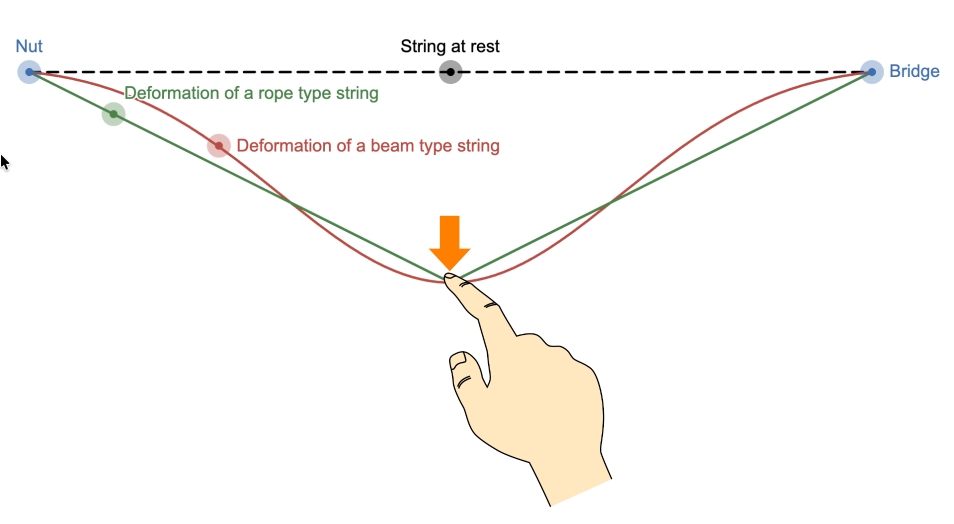
The smaller the diameter, the more the string behaves in an ideal manner—that is, like a “flex rope”—characterized by high flexibility and ease of deflection. Conversely, if the diameter is large, the string exhibits non-ideal behavior, functioning more like a “beam.” In this case, the significant moment of inertia results in high mechanical resistance (stiffness) to bending. In the event of deformation, the beam will exhibit a non-zero radius of curvature, particularly in the vicinity of the nut and the bridge.
This concept is easily understood by looking at the accompanying graph, which shows a string—fixed at both ends—under deformation. The rope-string will bend sharply right next to the nut and the bridge, resulting in a deformed shape composed of straight lines, in green. The beam-string, by contrast, due to its high moment of inertia, will exhibit a curvilinear deformation, in red. In the image, this deformation is exaggerated for the sake of clarity.
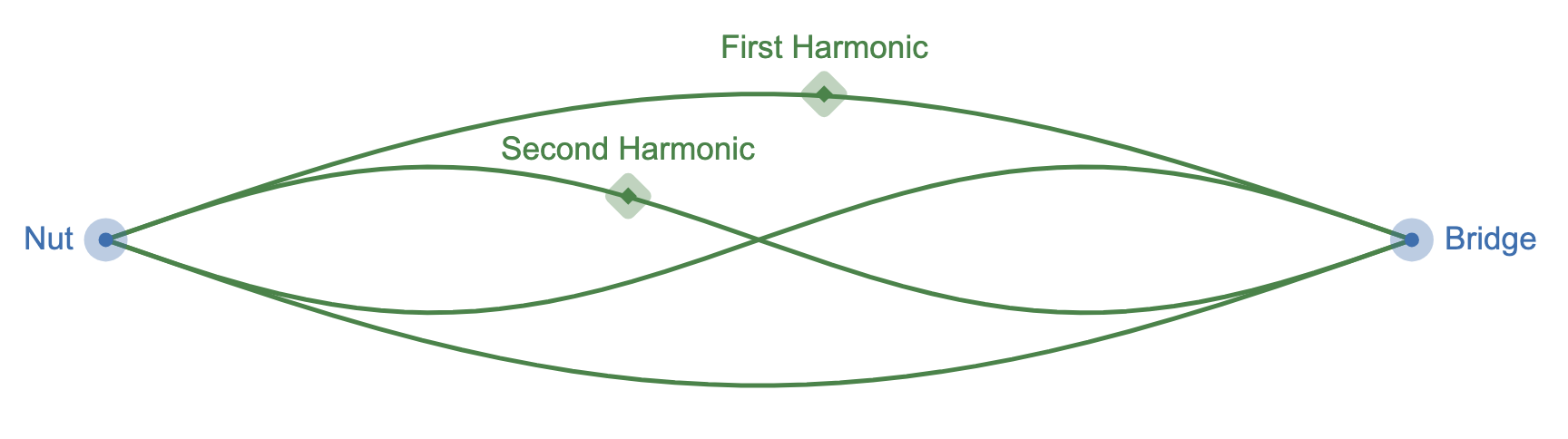
When a string is set into vibration, its envelope will differ depending on whether it behaves as a “rope” or a “beam” (I have illustrated both configurations for the first and second harmonics).
Let us first consider the ideal case: the “rope.” As shown in the image below, the bending at the ends occurs immediately adjacent to the nut and the bridge; consequently, the oscillation spans a maximum length equal to the theoretical length for each given harmonic. The extremities of the envelopes of the harmonics coincide.
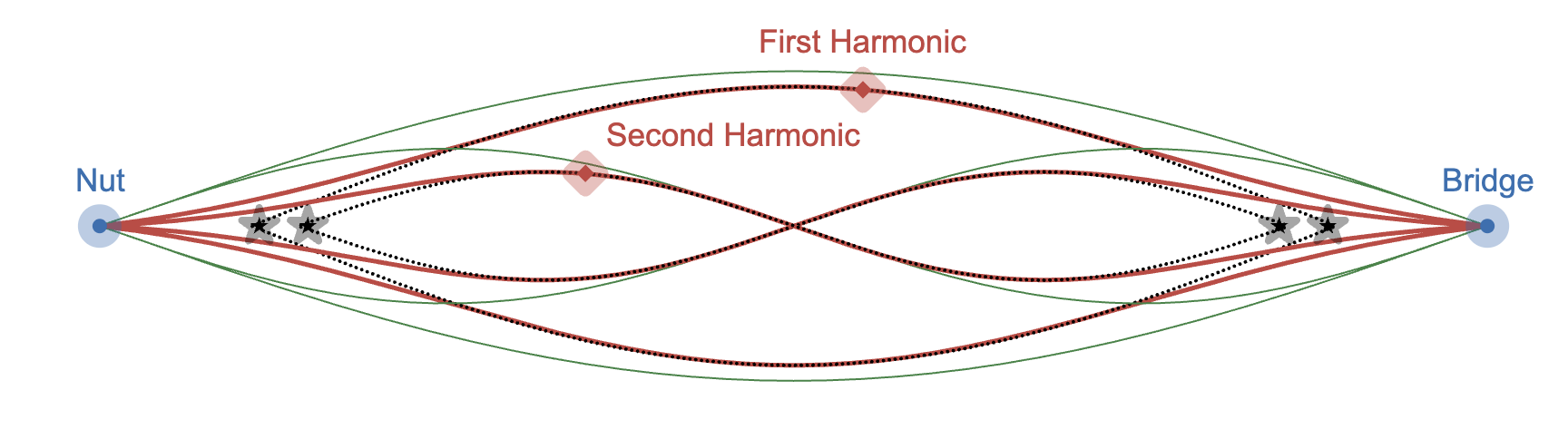
In the next graph, however, I report the envelope of the deformation of the non-ideal beam-string case in red color. The ideal rope-string case is reported in a continuous green thin line for comparison purposes.
It is noted that at the ends the beam-string is not able to flex perfectly, for this reason the equivalent wavelength of the vibration is not the maximum one (dotted black line), thus resulting in a different effective vibration frequency (normally it is higher). The same goes for the other harmonics.
Inharmonicity as distortion of the timbre’s harmonics
The problem, which is known by the term inharmonicity, is precisely linked to this non-ideality, i.e. the ratios of the higher frequencies with respect to the fundamental frequency (i.e. the first harmonic) are not integer numbers, and, moreover, this ratio varies from one harmonic index to another.
This can be seen as the effective wavelengths of the first and second harmonics do not share the same theoretical zeros (the two black stars are separate), as a consequence the second harmonic is not coincident with the 2x fundamental frequency.
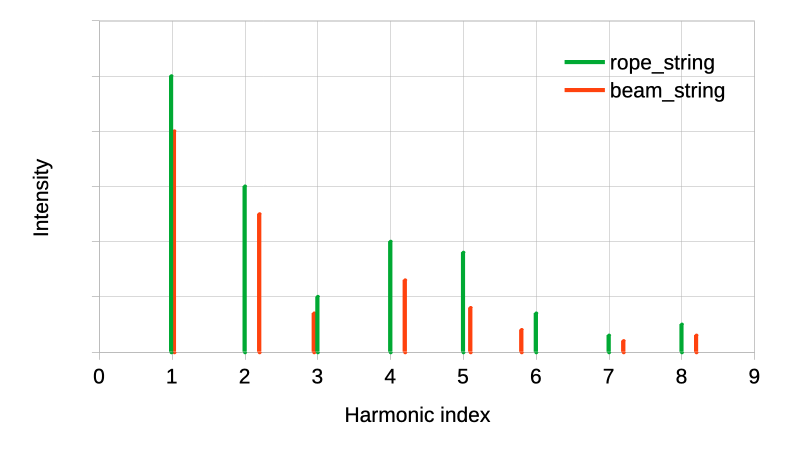
The spectrum of a vibrating string follows the frequency pattern shown in the graph below.
The green line represents the spectrum of a typical thin rope-string (with zero or negligible inharmonicity), while the red line represents the spectrum of a thick beam-string (with significant inharmonicity).
The amplitude of the harmonics in the beam-string case is smaller than in the rope-string case (lesser acoustic power), furthermore the upper harmonics of the beam-string are not centered on the multiple integer frequencies of the first harmonic (the fundamental).
This problem is also found in upright pianos, where the vibrating length is limited for reasons of space.
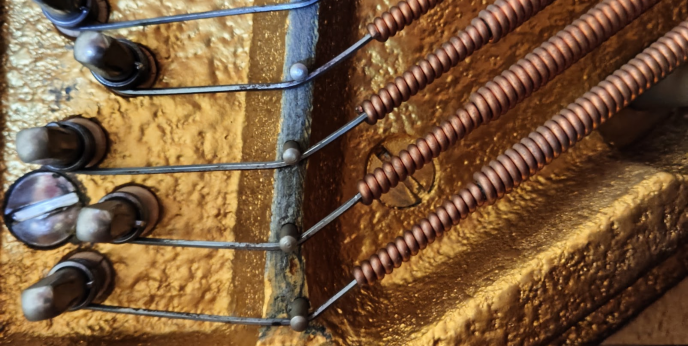
As an example, the bending of the lower strings (and therefore of large spinning diameters) is facilitated by starting the inertial wounding beyond the nut, thus allowing the string to bend as a rope for the maximum available length, thus minimizing inharmonicity. In reality the string far from the nut continue to behave as a beam.
Inharmonicity as the angular stiffness of a cantilever beam
As I have already written, if a string has a diameter that is too large in relation to its length, it behaves more like a beam than a string.
Let us therefore look at a well-known relationship for the deflection of a cantilevered beam subjected to a lateral load.
In mechanical engineering, this scenario is known as “cantilever beam deflection,” and there is an equation that models the deflection angle—or the slope at the free end—for a beam of length $L$ and moment of inertia $J$, subjected to a lateral force $F$ (in the image F is defined P).
\theta=\dfrac{FL^2}{2EJ}
It is clear that the degree of deflection of a beam increases with its flexibility (i.e., the smaller its Young’s modulus, E) and its slenderness (i.e., the smaller its diameter). For a gut string, one way to reduce the Young’s modulus is to increase the degree of twist. The length (L) and the lateral force applied at the end are not, ultimately, design parameters, as they depend on the instrument and the musician.
Now I will write down the equations for inharmonicity and the angle of deflection, having inverted the relationship. It took me some time to grasp these concepts as well, but ultimately it is clear that the inharmonicity and the angular stiffness of a loaded beam are physically and mathematically equivalent, up to a constant.
B=\pi^2\dfrac{EJ}{FL^2} \hspace{20mm} \theta^{-1}=2\dfrac{EJ}{FL^2}Inharmonicity as a delay in bow attack settling time
Another way to give practical meaning to inharmonicity is to consider its effect over time (in the previous examples, we illustrated its deformed shapes, thereby relating it to the physical space in which it manifests during the deflection of a string).
No virtuoso would want to play a string that exhibits inharmonicity, because in fast passages, no clear sound would emerge.
I will now attempt to explain this concept.
If we are dealing with inharmonicity, it implies that we are using a low-pitched string—for instance, the 3rd or 4th string of a cello, or the 6th or 7th string of a viola da gamba. Consequently, the notes produced by such a string will have a low frequency. For the sake of convenience, let us consider a frequency in the neighborhood of 50 Hz (quite close to an A1, based on a reference pitch—or corista—between 415 Hz and 392 Hz, corresponding to a product fL = 35-40 Hzm depending on the string length, between 70 cm and 80 cm).
This frequency has a period (the time it takes for the acoustic waveform to repeat) of 20 ms.
A virtuoso musician might wish to play thirty-second notes using the bow on this string. This would involve approximately 8 bow strokes per second, meaning the duration of a single bow stroke is about 120 ms.
Within the 120 ms duration of one bow stroke, there are 6 periods of 20 ms each, assuming an A1 note at 50 Hz is being played.
It now becomes clear that, in this context, the duration of a bow stroke is in competition with the duration of the waveform’s period!
It is a common experience that, when a bow first makes contact with a string, a certain amount of time—greater than zero—is required to set the string into vibration. During this transient phase, the string, initially at rest, is excited by the “stick-and-slip” action of the bow, facilitated by the friction provided by the rosin. Only after a specific interval does the vibration reach a steady state, in which the waveform repeats with the expected acoustic amplitude—the maximum amplitude associated with that particular playing technique.
I will present three scenarios, each characterized by a different degree of inharmonicity (low, medium, and high). In effect, inharmonicity acts as an inhibitor to the initiation of the string’s vibration, thereby introducing a delay in the settling time—the period required for the vibration to stabilize.
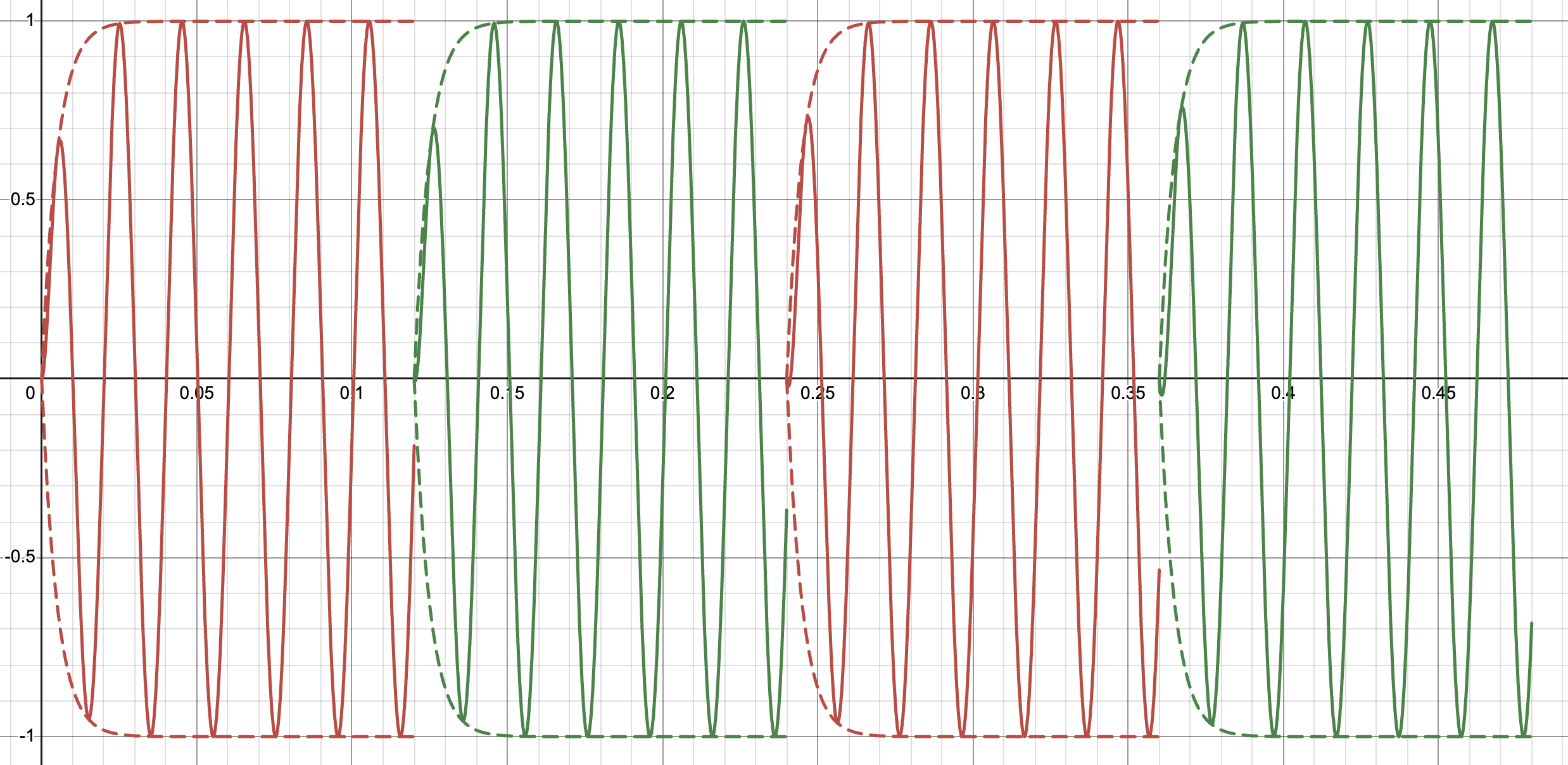
In the first graph, which features low inharmonicity, the string is highly responsive to contact with the bow and begins to oscillate rapidly. After just one 20 ms cycle, the waveform has already reached its steady state; in other words, the initial transient phase has concluded. The ear is then able to perceive five full cycles, allowing the frequency of the note being played to be heard with clarity and definition.
In the image shown here, the bow strokes in both directions are indicated in red and green. Each time the colors alternate, it means that the note has ended and the bow begins moving in the opposite direction.
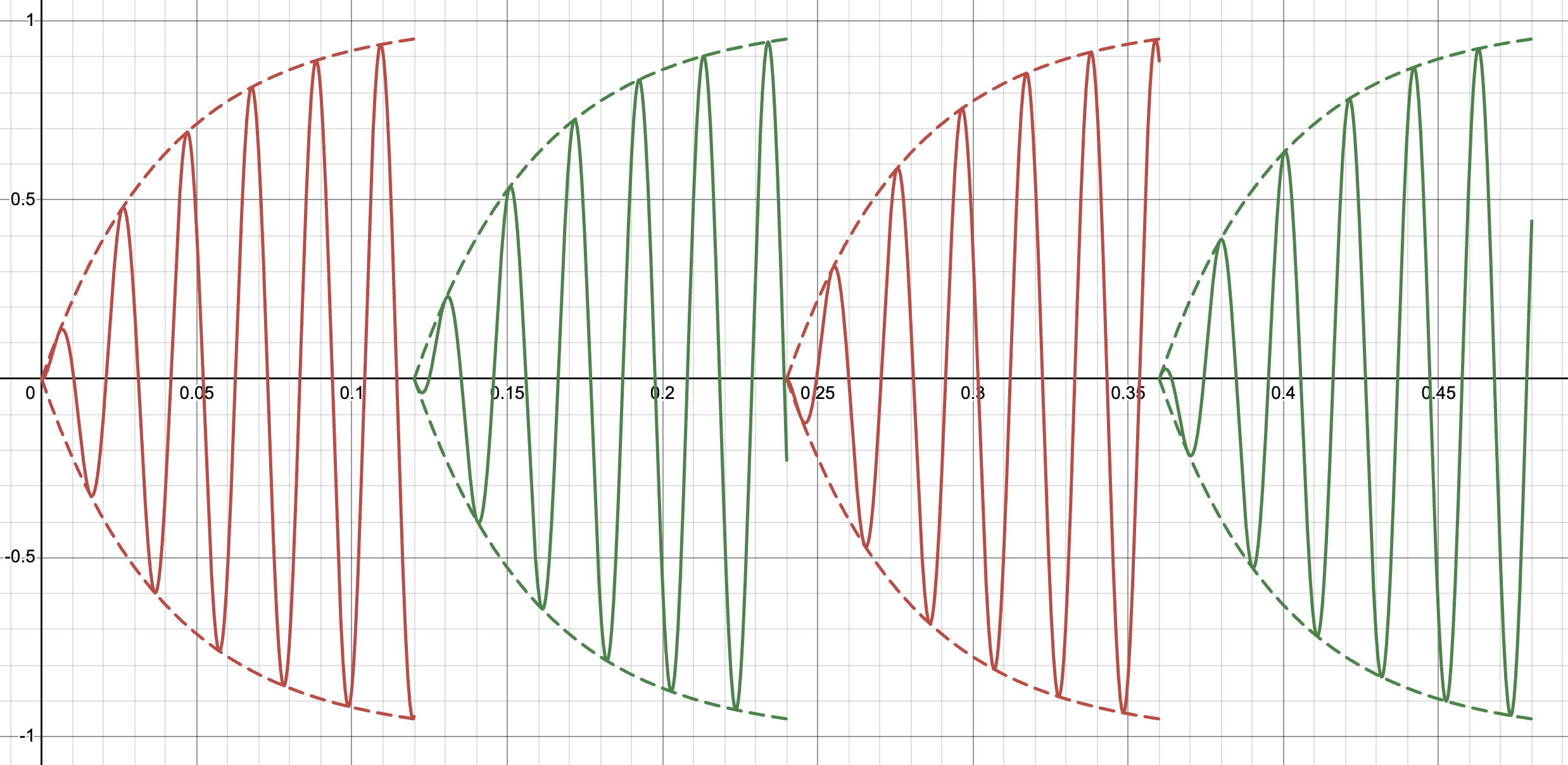
In the second example with a medium inharmonicity effect, the attack time is longer and spans nearly the entire duration of the bow stroke; only the sixth period reaches the asymptotic value. Yet, just a moment later, the bow changes direction again, and a new transient phase begins. In this case, the inharmonicity is significant and negatively affects the establishment of a well-defined, pleasing sound.
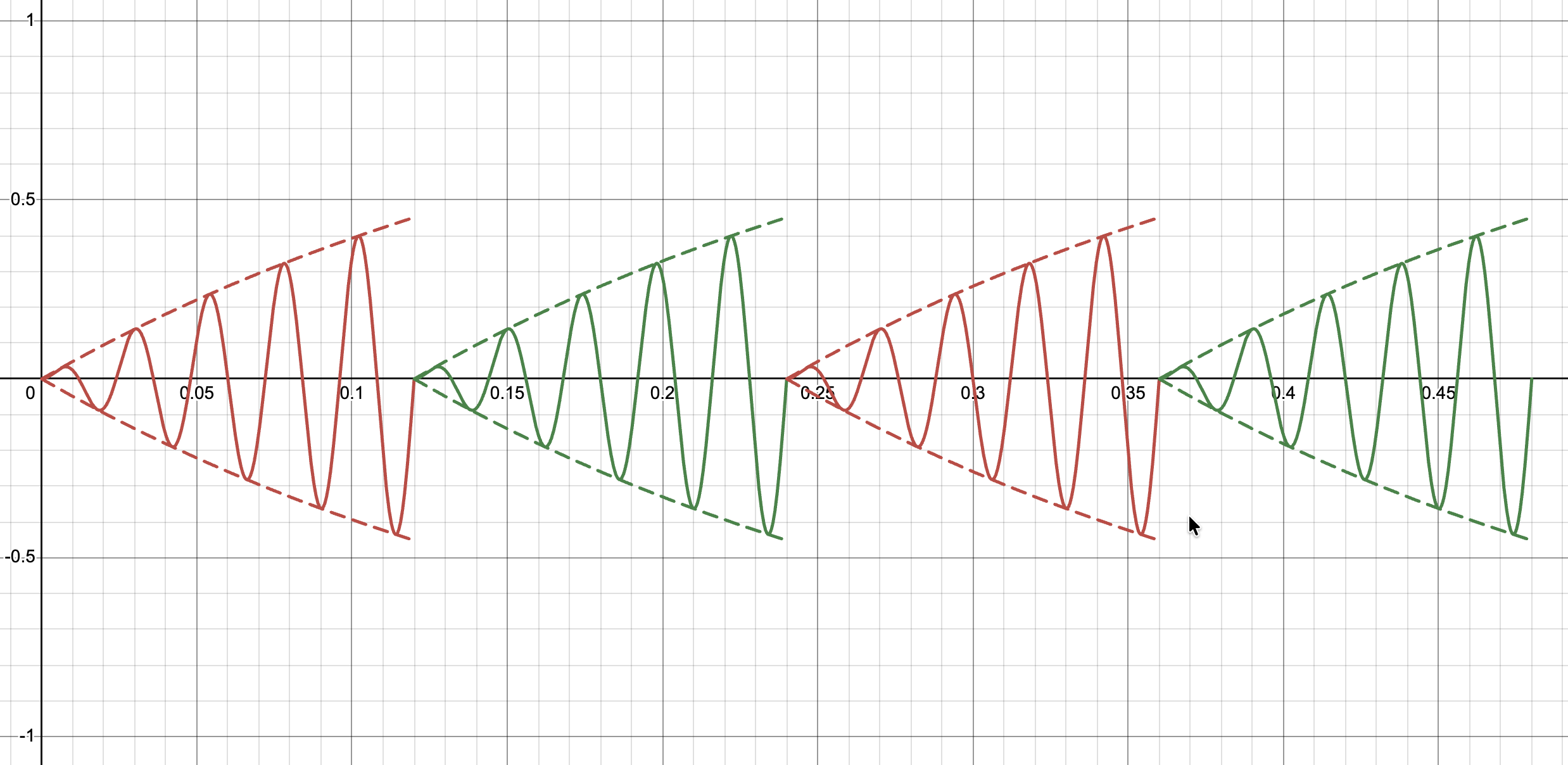
In the third case, characterized by very significant inharmonicity, the time required for the string to reach full vibration is much longer than the duration of the bow stroke; consequently, the sound never stabilizes. Instead, there is an alternation of chaotic and incoherent states, where the string is merely rubbed or scraped, making it impossible to produce a consistent tone. In this instance, inharmonicity has become the dominant factor, causing the string to behave more like a rigid beam—resistant to the transverse bending necessary for the propagation of vibrations—than like a flexible string.
While these examples certainly fail to capture the full complexity of a non-linear physical phenomenon involving numerous parameters, they do help explain why an inharmonic string is not a viable choice for a musician who wishes to offer a complete and well-defined sound across the entire harmonic spectrum—even during rapid, fleeting musical passages.
For example, research conducted by Mimmo Peruffo has shown that higher tension—which, by calculation, results in larger diameters and greater inharmonicity—leads to a shorter settling time for the vibration.
For this reason, a virtuoso attempting to play a string with a high degree of inharmonicity will readily describe it as “dull” and “noisy”—this is because, even as the musician changes the direction of the bow, the string has yet to begin vibrating in a coherent manner. What emerges is a sound—or rather, a noise—compounded by the percussive impact of the fingers pressing the string against the fingerboard; such a performance can hardly be considered musically satisfactory.
The solution is to use a “densified” string—one that is either wound or loaded with metal—as this allows the string to reach its optimal playing state more quickly.
Go to the gut string calculator tool.