
How do you design a string set for a generic violin family instrument?
What about inharmonicity and breaking index? What about equal tension and equal feel?
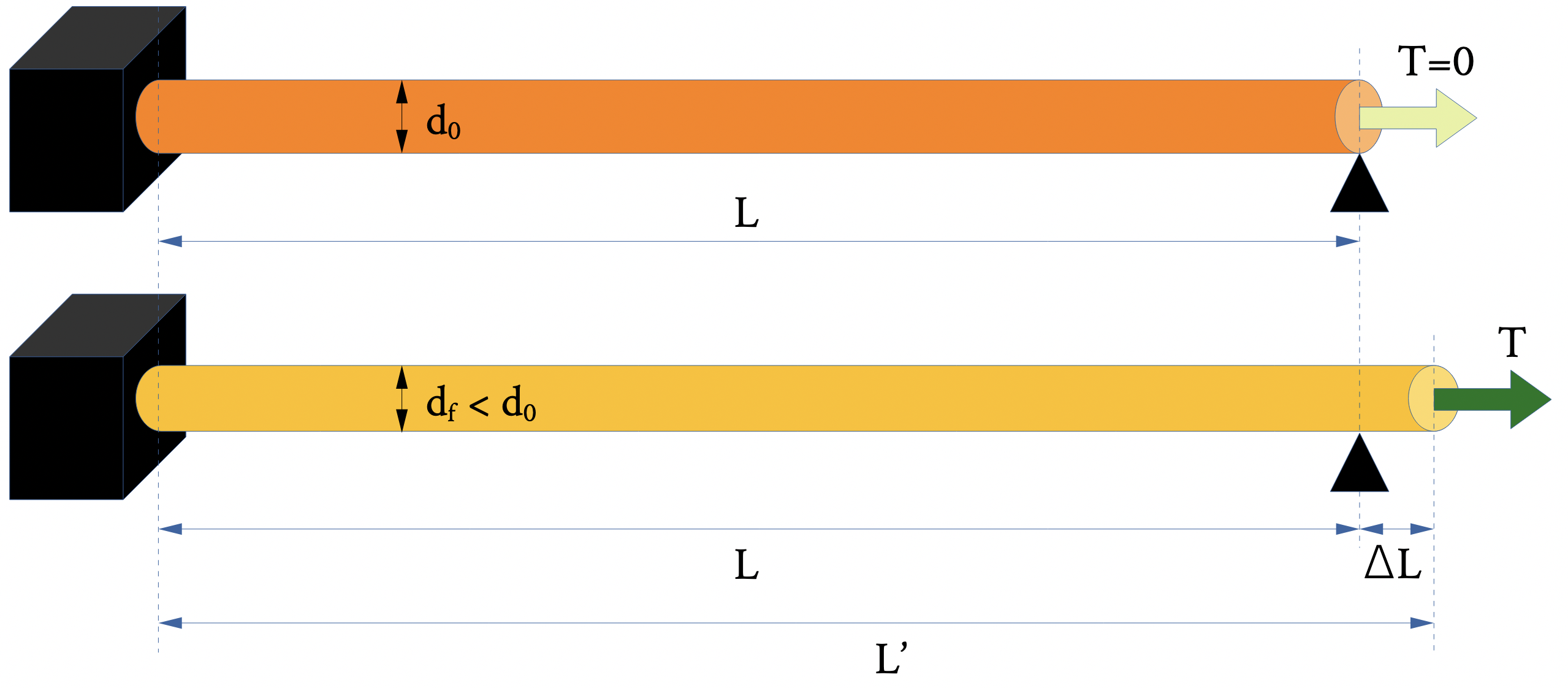
We now know that Mersenne’s law should not be used without accounting for the reduction in diameter that occurs when a string is stretched under tension.
We must adjust the theoretical string specifications to ensure that all strings have the same “operating” tension. I use the term “operating” specifically to distinguish it from “at rest”—that is, when the string is neither mounted nor under tension.
This approach is truly “equal (operating) tension,” as it ensures that all strings, when in use, are under the exact same amount of tension; it is called also as “equal feel”.
There is still a lot of confusion between these two concepts: as a result, many musicians (convinced that “equal tension” should be understood as “equal tension at rest” rather than “equal operating tension”) play instruments where the higher-pitched strings are “slacker” than the lower-pitched ones—a situation that is both undesirable and historically inaccurate.
The tool presented here allows for the selection of a set of pure gut strings for a given instrument—defined by its vibrating string length, number of strings, and tuning—while providing guidance to avoid inharmonicity in the lower register and string breakage in the higher register. The rule used to scale the fundamental parameter fL (the product of frequency and vibrating string length, in Hz·m) is derived from Michael Praetorius, as re-evaluated by Ephraim Segerman, and incorporates experimental observations in modern articles.
The analytical procedure, which aims to achieve uniform operating tension, is derived from the equations of structural mechanics. It assumes that gut has a Poisson’s ratio of 0.5 (implying volume conservation), a density of 1300 kg/m³, and a Young’s modulus of 2000 MPa.
Through an iterative process, the reduction in diameter under elongation was obtained by the calculation of the tensile stress, strain, lateral string stretching, and finally I achieved the correlation of the diameter size which permits the conservation of the volume.
As a result the diameter reduction percentage is defined as a function of fL, leading to the derivation of a quadratic regression function.
At the bottom of the page, two static tables are provided, the first plotting the fL range as a function of frequency and vibrating string length and the second plotting the percentual reduction of diameter due to the applied tension, from the rest condition to the operating condition.
It may seem like a coincidence, but for any given length L, there is only one specific combination of frequency and length that allows for the use of a fifth string.
I hope that at least one musician manages to use this tool and this table to visualize the issue and arrive at the correct interpretation of the “equal operating tension” concept.
Ultimately, the whole matter boils down to purchasing a set of strings with a gauge slightly larger than what Mersenne’s formula would suggest.
Table of percentual reduction of the string diameter from rest condition to operating condition [%]
For best visualization please open the page on a PC screen, not on a smartphone.
| Vibrating string length L [cm] | Copyright © Marco Pieri | Percentual reduction of the string diameter from rest condition to operating condition [%] |
www.marcopieriliutaio.it | |||||||||||||||||||||||||||||||||||
|---|---|---|---|---|---|---|---|---|---|---|---|---|---|---|---|---|---|---|---|---|---|---|---|---|---|---|---|---|---|---|---|---|---|---|---|---|---|---|
| 57 | 0,1 | 0,1 | 0,1 | 0,1 | 0,1 | 0,2 | 0,2 | 0,2 | 0,2 | 0,3 | 0,3 | 0,3 | 0,4 | 0,4 | 0,4 | 0,5 | 0,5 | 0,6 | 0,7 | 0,8 | 0,9 | 1,0 | 1,1 | 1,2 | 1,3 | 1,5 | 1,7 | 1,9 | 2,1 | 2,4 | 2,6 | 3,0 | 3,3 | 3,7 | 4,2 | 4,7 | 5,2 | 5,9 |
| 59,7 | 0,1 | 0,1 | 0,1 | 0,1 | 0,2 | 0,2 | 0,2 | 0,2 | 0,2 | 0,3 | 0,3 | 0,3 | 0,4 | 0,4 | 0,5 | 0,5 | 0,6 | 0,7 | 0,7 | 0,8 | 0,9 | 1,0 | 1,2 | 1,3 | 1,5 | 1,6 | 1,8 | 2,1 | 2,3 | 2,6 | 2,9 | 3,2 | 3,6 | 4,1 | 4,6 | 5,1 | 5,7 | 6,4 |
| 62,5 | 0,1 | 0,1 | 0,1 | 0,2 | 0,2 | 0,2 | 0,2 | 0,2 | 0,3 | 0,3 | 0,3 | 0,4 | 0,4 | 0,5 | 0,5 | 0,6 | 0,7 | 0,7 | 0,8 | 0,9 | 1,0 | 1,1 | 1,3 | 1,4 | 1,6 | 1,8 | 2,0 | 2,3 | 2,5 | 2,8 | 3,2 | 3,6 | 4,0 | 4,5 | 5,0 | 5,6 | 6,3 | 7,0 |
| 65,5 | 0,1 | 0,1 | 0,2 | 0,2 | 0,2 | 0,2 | 0,2 | 0,3 | 0,3 | 0,3 | 0,4 | 0,4 | 0,5 | 0,5 | 0,6 | 0,6 | 0,7 | 0,8 | 0,9 | 1,0 | 1,1 | 1,3 | 1,4 | 1,6 | 1,8 | 2,0 | 2,2 | 2,5 | 2,8 | 3,1 | 3,5 | 3,9 | 4,4 | 4,9 | 5,5 | 6,2 | 6,9 | 7,7 |
| 68,6 | 0,1 | 0,2 | 0,2 | 0,2 | 0,2 | 0,2 | 0,3 | 0,3 | 0,3 | 0,4 | 0,4 | 0,4 | 0,5 | 0,6 | 0,6 | 0,7 | 0,8 | 0,9 | 1,0 | 1,1 | 1,2 | 1,4 | 1,5 | 1,7 | 1,9 | 2,2 | 2,4 | 2,7 | 3,0 | 3,4 | 3,8 | 4,3 | 4,8 | 5,4 | 6,0 | 6,7 | 7,6 | 8,5 |
| 71,8 | 0,1 | 0,2 | 0,2 | 0,2 | 0,2 | 0,3 | 0,3 | 0,3 | 0,4 | 0,4 | 0,4 | 0,5 | 0,5 | 0,6 | 0,7 | 0,8 | 0,9 | 1,0 | 1,1 | 1,2 | 1,3 | 1,5 | 1,7 | 1,9 | 2,1 | 2,4 | 2,6 | 3,0 | 3,3 | 3,7 | 4,2 | 4,7 | 5,2 | 5,9 | 6,6 | 7,4 | 8,3 | 9,3 |
| 75,2 | 0,2 | 0,2 | 0,2 | 0,2 | 0,2 | 0,3 | 0,3 | 0,3 | 0,4 | 0,4 | 0,5 | 0,5 | 0,6 | 0,7 | 0,7 | 0,8 | 0,9 | 1,0 | 1,2 | 1,3 | 1,5 | 1,6 | 1,8 | 2,1 | 2,3 | 2,6 | 2,9 | 3,2 | 3,6 | 4,1 | 4,6 | 5,1 | 5,7 | 6,4 | 7,2 | 8,1 | 9,1 | 10,2 |
| 78,7 | 0,2 | 0,2 | 0,2 | 0,2 | 0,3 | 0,3 | 0,3 | 0,4 | 0,4 | 0,5 | 0,5 | 0,6 | 0,7 | 0,7 | 0,8 | 0,9 | 1,0 | 1,1 | 1,3 | 1,4 | 1,6 | 1,8 | 2,0 | 2,3 | 2,5 | 2,8 | 3,2 | 3,5 | 4,0 | 4,5 | 5,0 | 5,6 | 6,3 | 7,0 | 7,9 | 8,8 | 9,9 | 11,1 |
| 82,6 | 0,2 | 0,2 | 0,2 | 0,3 | 0,3 | 0,3 | 0,4 | 0,4 | 0,5 | 0,5 | 0,6 | 0,6 | 0,7 | 0,8 | 0,9 | 1,0 | 1,1 | 1,3 | 1,4 | 1,6 | 1,8 | 2,0 | 2,2 | 2,5 | 2,8 | 3,1 | 3,5 | 3,9 | 4,4 | 4,9 | 5,5 | 6,2 | 6,9 | 7,7 | 8,7 | 9,7 | 10,9 | 12,2 |
| 86,3 | 0,2 | 0,2 | 0,3 | 0,3 | 0,3 | 0,4 | 0,4 | 0,4 | 0,5 | 0,6 | 0,6 | 0,7 | 0,8 | 0,9 | 1,0 | 1,1 | 1,2 | 1,4 | 1,5 | 1,7 | 1,9 | 2,2 | 2,4 | 2,7 | 3,0 | 3,4 | 3,8 | 4,3 | 4,8 | 5,3 | 6,0 | 6,7 | 7,5 | 8,4 | 9,5 | 10,6 | 11,9 | 13,4 |
| A=440 Hz | F | Gb | G | Ab | A | Bb | B | C | Db | D | Eb | E | F | Gb | G | Ab | A | Bb | B | C | Db | D | Eb | E | F | Gb | G | Ab | A | Bb | B | C | Db | D | Eb | E | F | Gb |
| A=415 Hz | Gb | G | Ab | A | Bb | B | C | Db | D | Eb | E | F | Gb | G | Ab | A | Bb | B | C | Db | D | Eb | E | F | Gb | G | Ab | A | Bb | B | C | Db | D | Eb | E | F | Gb | G |
| A=392 Hz | G | Ab | A | Bb | B | C | Db | D | Eb | E | F | Gb | G | Ab | A | Bb | B | C | Db | D | Eb | E | F | Gb | G | Ab | A | Bb | B | C | Db | D | Eb | E | F | Gb | G | Ab |
| Real frequency f [Hz] | 43,7 | 46,2 | 49,0 | 51,9 | 55,0 | 58,3 | 61,7 | 65,4 | 69,3 | 73,4 | 77,8 | 82,4 | 87,3 | 92,5 | 98,0 | 104 | 110 | 117 | 123 | 131 | 139 | 147 | 156 | 165 | 175 | 185 | 196 | 208 | 220 | 233 | 247 | 262 | 277 | 294 | 311 | 330 | 349 | 370 |